
Introduction: Understanding Pressure Measurement with Manometers
Pressure measurement plays a critical role in engineering, industrial processes, HVAC systems, laboratories, and fluid mechanics. One of the oldest yet most accurate instruments used for this purpose is the manometer.
A manometer is a device used to measure pressure in gases or liquids by comparing the unknown pressure with a reference pressure, usually atmospheric pressure. Unlike electronic pressure sensors, manometers operate on simple physical principles, making them highly reliable, accurate, and easy to understand.
Despite the rise of digital pressure transmitters, manometers are still widely used for calibration, educational purposes, and low-pressure measurements because of their simplicity and precision.
What Is a Manometer?
A manometer is a pressure-measuring instrument that determines pressure by balancing it against the hydrostatic pressure of a liquid column.
In simple words:
A manometer measures pressure by observing how much a liquid moves inside a tube when pressure is applied.
Manometers are commonly filled with:
- Mercury
- Water
- Oil
- Alcohol
The movement of this liquid provides a direct indication of pressure difference.
Basic Working Principle of a Manometer
A manometer works on a very simple and natural principle of fluid behavior called hydrostatic equilibrium. This principle explains how liquids behave when they are at rest.
What Does Hydrostatic Equilibrium Mean?
When a liquid is not moving:
- The pressure is the same at all points that are at the same horizontal level in the liquid.
- If pressure is applied at one point, the liquid will move until the pressure becomes balanced again.
In a manometer, this balancing action is used to measure pressure.

How Pressure Causes Liquid Movement
When pressure is applied to one side of a manometer:
- The liquid is pushed down on the side where the pressure is higher.
- At the same time, the liquid rises up on the opposite side.
- The liquid continues to move until the weight of the liquid column balances the applied pressure.
The vertical height difference between the liquid levels on both sides tells us how much pressure is being applied.
Pressure Calculation Formula
The pressure difference is calculated using this simple equation:P=ρ×g×h
Where:
- P = pressure difference between the two sides
- ρ (rho) = density of the liquid used in the manometer
- g = acceleration due to gravity
- h = difference in height between the liquid levels
Why This Works So Well
- A denser liquid (like mercury) gives accurate readings even for high pressure.
- A lighter liquid (like water or oil) is better for measuring small pressures.
- Gravity acts the same everywhere, so the measurement remains stable and reliable.
What Happens Inside a Manometer
Look at the image above and imagine a U-shaped transparent tube partially filled with a liquid such as water or mercury.
- Equal Pressure at Rest
- When no external pressure is applied, the liquid stays at the same level on both sides.
- This is because the pressure is equal at the same horizontal level.
- Pressure Applied on One Side
- When pressure is applied to one side of the tube, it pushes the liquid downward on that side.
- The liquid then rises on the opposite side.
- Balancing of Forces
- The liquid stops moving only when the weight of the raised liquid column balances the applied pressure.
- At this point, the system reaches hydrostatic equilibrium again.
What the Height Difference Means

The vertical height difference (h) between the two liquid levels is the key measurement.
- Small pressure → small height difference
- Large pressure → large height difference
This height difference directly tells us how much pressure is being applied.
Pressure Relationship
The pressure difference is calculated using:P=ρ×g×h
Where:
- P = pressure difference
- ρ (rho) = density of the liquid
- g = acceleration due to gravity
- h = height difference of liquid columns
Classic Example: U-Tube Manometer

Construction
A U-tube manometer consists of:
- A transparent U-shaped tube
- Manometric liquid partially filled
- One end connected to the pressure source
- Other end open to the atmosphere (or another pressure source)
Working
- If the applied pressure is greater than atmospheric pressure, the liquid level falls on the pressure side and rises on the other side
- The vertical height difference represents pressure difference
Advantages
- High accuracy
- Simple design
- No power or calibration required
Limitations
- Bulky
- Not suitable for very high pressures
- Manual reading required
Classification of Manometers
Manometers are broadly classified into:
- Simple Manometers
- Differential Manometers
Each type is designed for specific pressure measurement needs.
1. Simple Manometers
Simple manometers measure pressure relative to atmospheric pressure.
a) Piezometer
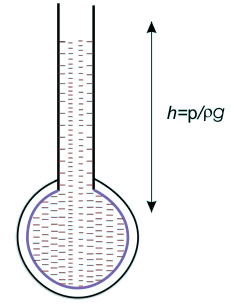
A piezometer is one of the simplest pressure-measuring devices used in fluid mechanics. It is mainly used to measure the pressure of liquids, especially water, at a particular point in a pipe or container. Because of its simplicity, it is often taught first when learning about pressure measurement.
Construction of a Piezometer
The construction of a piezometer is very straightforward:
- It consists of a vertical transparent glass tube
- The lower end of the tube is connected to the point where pressure is to be measured (for example, a water pipe)
- The upper end of the tube is open to the atmosphere
There are no moving parts, valves, or gauges, which makes the piezometer easy to install and understand.
Working Principle (How a Piezometer Works)
Liquid rises in the tube until its hydrostatic pressure balances the applied pressure.
When a piezometer is connected to a pipe carrying liquid:
- The pressure of the liquid pushes the liquid upward into the vertical tube
- The liquid continues to rise until the weight of the liquid column balances the pressure at the connection point
- Once balance is achieved, the liquid stops rising
The height of the liquid column in the tube directly represents the pressure at that point in the pipe.
Advantages
- Very simple
- Low cost
Limitations
- Works only for liquids
- Not suitable for high pressure
- Requires vertical space
Applications
- Water pipelines
- Open channel flow analysis
b) U-Tube Manometer
(Already explained above)
Common Uses
- Gas pressure measurement
- Laboratory experiments
- Calibration of pressure instruments
c) Single Column Manometer
Construction
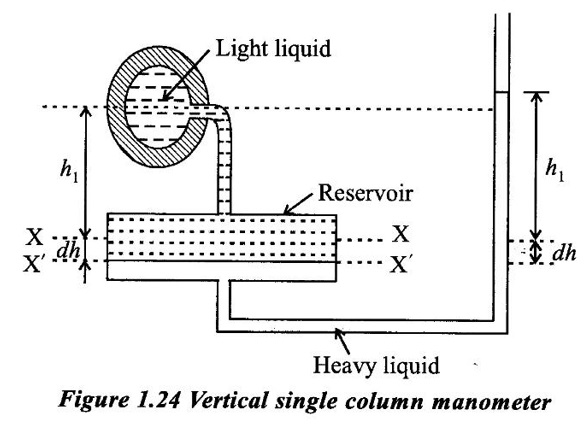
- One limb enlarged into a reservoir
- Other limb is narrow and vertical or inclined
Working
Because of the large reservoir area, even a small pressure causes noticeable movement in the narrow tube.
Advantages
- Higher sensitivity
- More accurate than U-tube for low pressure
Applications
- Low-pressure gas measurement
- Laboratory use
2. Differential Manometers
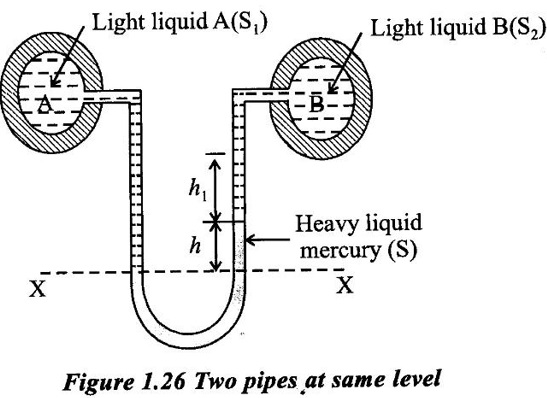
Differential manometers measure the difference between two pressures.
a) Differential U-Tube Manometer

Construction
- Both ends of the U-tube connected to two pressure points
Working
The difference in liquid height represents the pressure difference between the two points.
Applications
- Pressure drop across filters
- Flow measurement devices
- Heat exchangers
b) Inverted U-Tube Manometer

Special Feature
Uses a low-density fluid like oil or alcohol.
Advantages
- Measures very small pressure differences
- Suitable for gas flow measurement
📌 Applications
- Ventilation systems
- Airflow measurement
c) Inclined Manometer

Why Inclined?
The inclination increases the scale length, making small pressure changes easier to read.
Advantages
- Extremely sensitive
- High resolution
Applications
- HVAC systems
- Cleanroom pressure monitoring
Let’s talk about Manometer gauge a little bit.
Manometer Gauge

A manometer gauge is a manometer used to measure gauge pressure—that is, pressure relative to atmospheric pressure. In everyday terms, it tells us how much higher or lower the pressure is compared to the surrounding air.
What Does “Gauge Pressure” Mean?
- Atmospheric pressure is the pressure of the air around us.
- Gauge pressure is the pressure above or below atmospheric pressure.
To know more about Gauge Pressure in detail, please read the article “What is Barometric Pressure?”.
A manometer naturally measures this difference, which is why it works as a gauge.
How a Manometer Works as a Gauge
In a typical U-tube manometer gauge:
- One side of the tube is connected to the system (pipe, tank, or duct).
- The other side is open to the atmosphere.
- The tube is partially filled with a liquid (water, oil, or mercury).
When pressure is applied from the system:
- The liquid level moves down on the pressure side.
- The liquid level moves up on the atmospheric side.
- The height difference (h) between the two levels shows the gauge pressure.
The manometer directly compares system pressure with atmospheric pressure—this comparison is what makes it a pressure gauge.
Manometric Fluids Used
| Fluid | Density | Typical Use |
|---|---|---|
| Mercury | Very high | High pressure, compact design |
| Water | Low | Low pressure |
| Oil | Medium | Gas pressure |
| Alcohol | Very low | Very small pressure differences |
Mercury is avoided today due to environmental concerns.
Applications of Manometers
Some real-life installations are shown below.


Manometers are widely used in:
- HVAC duct pressure measurement
- Chemical and process industries
- Fluid mechanics laboratories
- Flow measurement systems
- Gas pipelines
- Boilers and furnaces
- Calibration of pressure sensors
- Educational demonstrations
Advantages of Manometers
Simple construction
High accuracy
No external power required
Cost-effective
Ideal for calibration and teaching
Limitations of Manometers
Bulky compared to electronic sensors
Manual reading
Not suitable for dynamic pressure
Limited to low and medium pressures
Manometer vs Pressure Gauge
| Feature | Manometer | Pressure Gauge |
|---|---|---|
| Accuracy | Very high | Moderate |
| Power | Not required | May require |
| Calibration | Not needed | Required |
| Cost | Low | Higher |
| Best Use | Calibration, labs | Industrial monitoring |
Now a days Digital manometers are gaining popularity. read below.
Digital Manometer

A digital manometer is a modern pressure-measuring instrument that uses electronic sensors and a digital display instead of a liquid column. It measures gas or air pressure quickly and accurately and shows the reading directly on a screen, making it easier to use than traditional liquid manometers.
In simple words:
A digital manometer measures pressure electronically and displays the value as numbers on a screen.
What Is a Digital Manometer?
A digital manometer is an electronic pressure gauge designed to measure:
- Gauge pressure
- Differential pressure
- Sometimes absolute pressure
Instead of observing liquid height, the user reads pressure values directly in units such as:
- Pa (Pascal)
- kPa
- bar
- psi
- mmH₂O or inH₂O
Basic Working Principle of a Digital Manometer

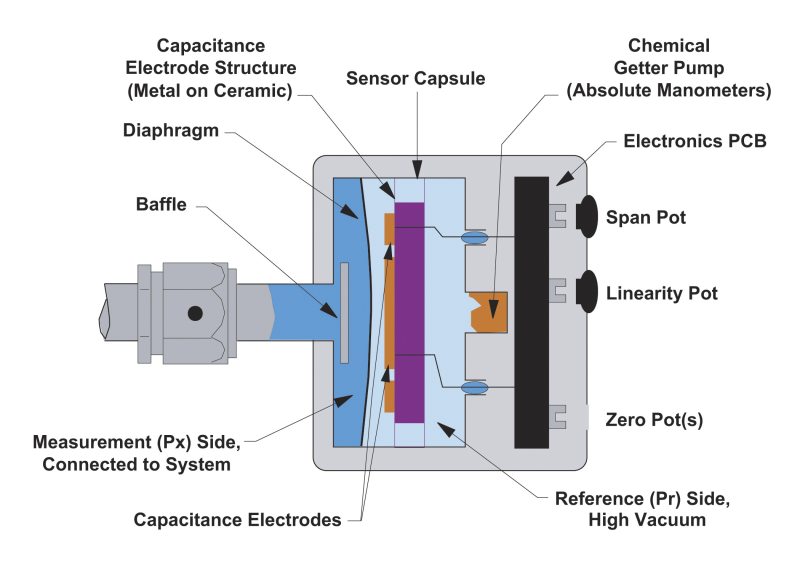
A digital manometer works using a pressure sensor (usually a piezoresistive or capacitive sensor).
Step-by-Step Working
- Pressure Applied
Pressure from a gas or air source enters the manometer through a port. - Sensor Detects Pressure
The internal sensor slightly deforms when pressure is applied. - Electrical Signal Generated
This deformation is converted into an electrical signal. - Signal Processing
The electronics convert the signal into a pressure value. - Digital Display
The pressure value is shown instantly on the screen.
📌 Key Difference from Liquid Manometer:
No liquid movement—everything happens electronically.
Types of Digital Manometers
1. Digital Gauge Manometer
- Measures pressure relative to atmospheric pressure
- Used in HVAC and gas lines
2. Digital Differential Manometer
- Measures pressure difference between two points
- Has two pressure ports
- Common in air ducts and filters
3. Digital Absolute Manometer
- Measures pressure relative to a vacuum reference
- Used in laboratories and scientific applications
Key Features of a Digital Manometer
- Clear digital display
- Multiple pressure units
- High accuracy
- Fast response time
- Battery operated
- Data hold and zero functions (in many models)
Advantages of Digital Manometers
Very easy to read
High accuracy and repeatability
Compact and portable
Measures very small pressure differences
Ideal for field and industrial use
Limitations of Digital Manometers
Requires power (battery)
More expensive than liquid manometers
Needs periodic calibration
Sensitive to harsh environments (heat, moisture)
Applications of Digital Manometers
Digital manometers are widely used in:
- HVAC systems (air duct pressure, filter testing)
- Cleanrooms and hospitals
- Gas pipelines
- Laboratory experiments
- Industrial process control
- Calibration of pressure instruments
- Environmental monitoring
Digital Manometer vs Liquid Manometer
| Feature | Digital Manometer | Liquid Manometer |
|---|---|---|
| Reading | Digital display | Liquid height |
| Accuracy | High | Very high |
| Ease of use | Very easy | Manual |
| Portability | High | Low |
| Power needed | Yes | No |
| Maintenance | Calibration required | Minimal |
Simple Real-Life Example
An HVAC technician uses a digital differential manometer to measure pressure drop across an air filter. The instrument instantly displays the pressure difference in Pa, helping decide whether the filter needs replacement.
A manometer is one of the most fundamental and reliable pressure-measuring instruments ever developed. Even in the era of digital sensors, manometers remain essential due to their accuracy, simplicity, and trustworthiness.
Understanding what a manometer is, its types, working principle, and applications is crucial for students, engineers, technicians, and anyone working with fluid systems and pressure measurement.